Showing posts with label Know your classics: Passé-carton/ Franse band. Show all posts
Tuesday, July 28, 2015
Sunday, July 5, 2015
Villa des roses: gilding
Een van mijn favorieten technieken: titelvergulden, vrij uit de hand en met losse handletters.
One of my favorite gildingtechniques for titleling, free out of hand and with single handletters.
Saturday, October 22, 2011
Passé-carton/Franse band: Finished Binding
Om dit project af te ronden: enkele foto's van de afgewerkte band.
In order to complete this project: some pictures of the finished binding.
Sunday, October 16, 2011
Passé-carton/Franse band: gilding and leather hinge
Geplaatst scharnier.
Applyed hinge.
Aanbrengen lederen scharnieren: voorbereiden van het scharnier.
Apply leather hinges: preparing the hinge.
Ook de titel wordt in gouddruk aangebracht. Alle verguldwerk wordt met echt goud uitgevoerd.
The title is gilded. All gilding is done with genuine gold.
Het verguldwerk voor dit boek is vrij sober. Naast de ribben wordt er een gouden lijntje gedrukt.
The gilding for this book is quite simple. Besides the bands, a golden line added.
Nadat het leder gedroogd is wordt het boek voorzichtig geopend.
After the leather is completly drie, the book is opened carefully.
Applyed hinge.
Aanbrengen lederen scharnieren: voorbereiden van het scharnier.
Apply leather hinges: preparing the hinge.
Ook de titel wordt in gouddruk aangebracht. Alle verguldwerk wordt met echt goud uitgevoerd.
The title is gilded. All gilding is done with genuine gold.
Het verguldwerk voor dit boek is vrij sober. Naast de ribben wordt er een gouden lijntje gedrukt.
The gilding for this book is quite simple. Besides the bands, a golden line added.
Nadat het leder gedroogd is wordt het boek voorzichtig geopend.
After the leather is completly drie, the book is opened carefully.
Sunday, October 2, 2011
Passé-carton/Franse band: Covering
Mission completed: bekleed boek, met het leder nog vochtig.
Mission completed: covered book, with the leather is still damp.
To coiffe or not to coiffe.
Het scherp zetten van de ribben, met het boek in een vals foedraal. Nadien wordt de ribbentang bovengehaald om ze nog beter scherp te zetten.
The "sharpening" of the bands, with the book in a "false case". Then the bandnipper is used to put them even more sharply.
Het leder pas aangebracht.
The leather just applied.
Voor een Franse band gebruik ik zeer graag het hoogwaardige Oasis geitenleder van Harmatan
( http://www.harmatan.co.uk/ ). Voor dit groot boek heb ik een vel buiten formaat aangeschaft, een reuzegeit.
Voor de doublures gebruik ik hier een handmarmer van Antonio Vélez Celemin (http://www.antoniovelezcelemineningles.blogspot.com/) Een buitengewoon getalenteerde marmeraar uit Spanje.
For the Passé-carton, I really like to use high uality Oasis goatleather of Harmatan
(Http://www.harmatan.co.uk/). For this book I have ordered a skin of a giant goat.
For the pastdown and flyleaves I use a handmarble of Antonio Vélez Celemin (http://www.antoniovelezcelemineningles.blogspot.com/) An exceptionally talented artist from Spain.
Sunday, September 25, 2011
Passé-carton/Franse Band: Sanding & bands
Het plaatsen van de valse ribben.
Putting on the false bands.
Bovenaanzicht met kaphoekjes.
Topview with back cornering.
Geschuurde borden. Let op de mica plaat: een zeer efficiënte alternatief voor de valse katernen. Zie ook de Cockrambinding.
Sanded boards. Notice the mica plate: a highly efficient alternative to the fake signatures. See also Cockrambinding.
Het schuren van de borden: schuren en schuren en nog eens schuren,.....
Sanding the boards: sanding and sanding and sanding again,.....
Sunday, September 18, 2011
Passé-carton/Franse Band: Putting on the back.
De bristolrug wordt rechtstreeks op de rug van het boek gekleefd.
The spine-piece is stucked directly on the back of the book.
Voorgevormde bristol rug.
Preformed bristol spine-piece.
Uitvlakken van de rug met Japans papier en warme lijm.
Flattening of the spine with Japanese paper as a filler and hot glue.
Afwerken van de rug: Kolven van de rug.
Finishing the spine: Smoothing the spine of the book.
Sunday, September 11, 2011
Passé-carton/Franse band: putting on the boards
Boek met aangehechte borden.
Book with attached boards.
Even persen met het bord tussen 2 zinken platen.
A quick pressing with the boards between two zinc plates.
Twee bristols worden toegevoegd.
Two Bristols are added.
Aanhechten van de borden:
De touwen worden door het bord geregen en verzadigd met bloempap.
Attaching the boards:
The cords are threaded through the boards and saturated with glue.
Monday, August 29, 2011
Passé-carton/ Franse Band: Preparing the boards
Vervaardigen van de groeven voor de naaitouwen,...
Making of the grooves for the cords,.....
Aangebracht cambreerblad zorgt voor de juiste trekkracht en beschermd tegelijkertijd.
Added paper ensures the correct tension to the board and protected simultaneously.
Vanwege het bijwonen van de interessante Education & Training Confernce van de Society of Bookbinders van het afgelopen weekend komt het berichtje iets later deze week,...Maar hier zijn we dan weer,..
De borden van een Franse band worden steeds gemaakt van het hoogwaardigste karton. Hier afgebeeld zijn:
- Blauwbord: zeer sterk , maar jammer genoeg niet meer te krijgen.
- Groen Millboard: zeer sterk, zuurvrij en gebufferd.
- Lilla Eternoboard: sterk, zuurvrij en gebufferd.
-
The boards of a Passé-carton are always made from highest quality cardboard. Shown here:
Blauwbord: very strong, but unfortunately no longer available.
Green Mill Board: very strong, acid free and buffered.
Lilla Eterno Board: strong, acid-free and buffered
Sunday, August 21, 2011
Passé-carton/ Franse Band: Headbands
Op de rug wordt het kapitaalbandje verstevigd met een stuk Japans papier (minimale dikte, maximale sterkte).
On the back of the book the headband is reinforced with a piece of Japanese paper (minimum thickness, maximum strength).
En vervolgens wordt het kapitaalbandje genaaid.
Then the headband is sewn.
Het boek in de pers gefixeerd.
The book put down in the press.
De belangrijkste handleidingen over kapitaalbanden zijn:
- Headbands, How to work them, Jane Greenfield & Jenny Hille, Oak Knoll Press
- Les tranchefiles brodées, etude historique et technique, Bibliothèque Nationale
- DieKapitale, Claus Maywald-Pitellos & Friedrich Prenzlau
Tips over andere handleidingen zijn altijd welkom!!
Voor dit boek gebruik ik een Frans kapitaalband, met een enkele kern van leder & perkament. De andere benodigdheden zijn: een naald, een stukje Japans papier en natuurlijk verschillende kleuren zijdedraad.
The most important manuals on headbands are:
- Headbands, How to work them, Jane Greenfield & Jenny Hille, Oak Knoll Press
- Les tranchefiles brodées, etude historique et technique, Bibliothèque Nationale
- DieKapitale, Claus Maywald-Pitellos & Friedrich Prenzlau
For this book I use a French headband with a single core of leather and parchment. Other requirements are: a needle, a piece of Japanese paper and fine silk thread in different colors.
Sunday, August 14, 2011
Passé-carton/ Franse Band: Backing & Co
Vervolgens wordt het geheel weerom 24 uur geperst zodat de lijm volledig kan uitharden en de gekneepte vorm behouden blijft.
Then the book will be once again pressed for 24 houres. So the adhesive can dry enterely and form of the backed book be maintained.
De rug wordt kneepgeslagen, en van konijnenvellenlijm en open gaasweefsel voorzien,...
Backing of the book. This is done in a backing press: animal glue and a kind of open woven fabric is added.
Het boekblok wordt gerond.
The bookblock is rounded with hammer or just the fingers.
Er worden tijdelijke vellen papier toegevoegd, waardoor het boekblok beschermd wordt tegen vuil, lijm,... bij de volgende bewerkingen.
There are temporary sheets of paper added, which protect the bookblock from dirt, glue, ... that could be the result the following operations.
De volgende stappen laten het boekblok zijn definitieve vorm aannemen.
Het "flossen" van de vlastouwen.
The following steps determine the bookblock in its final form.
The "unwinding" of the flax cords.
Sunday, August 7, 2011
Passé-carton/ Franse Band: Sewing
Het boek wordt doorlopend genaaid, met verzonken touwen.
The book is sewn with recessed cords.
De naaistations worden gemaakt dmv een zaagje. Eventueel bestaande naaistations worden zoveel als mogelijk overgenomen. De diepte van de gaten is gelijk aan de dikte van het touw.
The sewing stations are created by using a saw. Any existing sewing stations are reused as much as possible. The depth of the holes is equal to the thickness of the cord.
Volgende stap is het naaien van het boekblok. De plaatsen van de naaistations worden overgenomen van een Gabarit. Snel en gemakkelijk.
Next step is to sew the book block. The locations of the sewing stations are taken from a Gabarit. easy and fast
Sunday, July 31, 2011
Passé-carton/ Franse Band: protection, checking & pressing
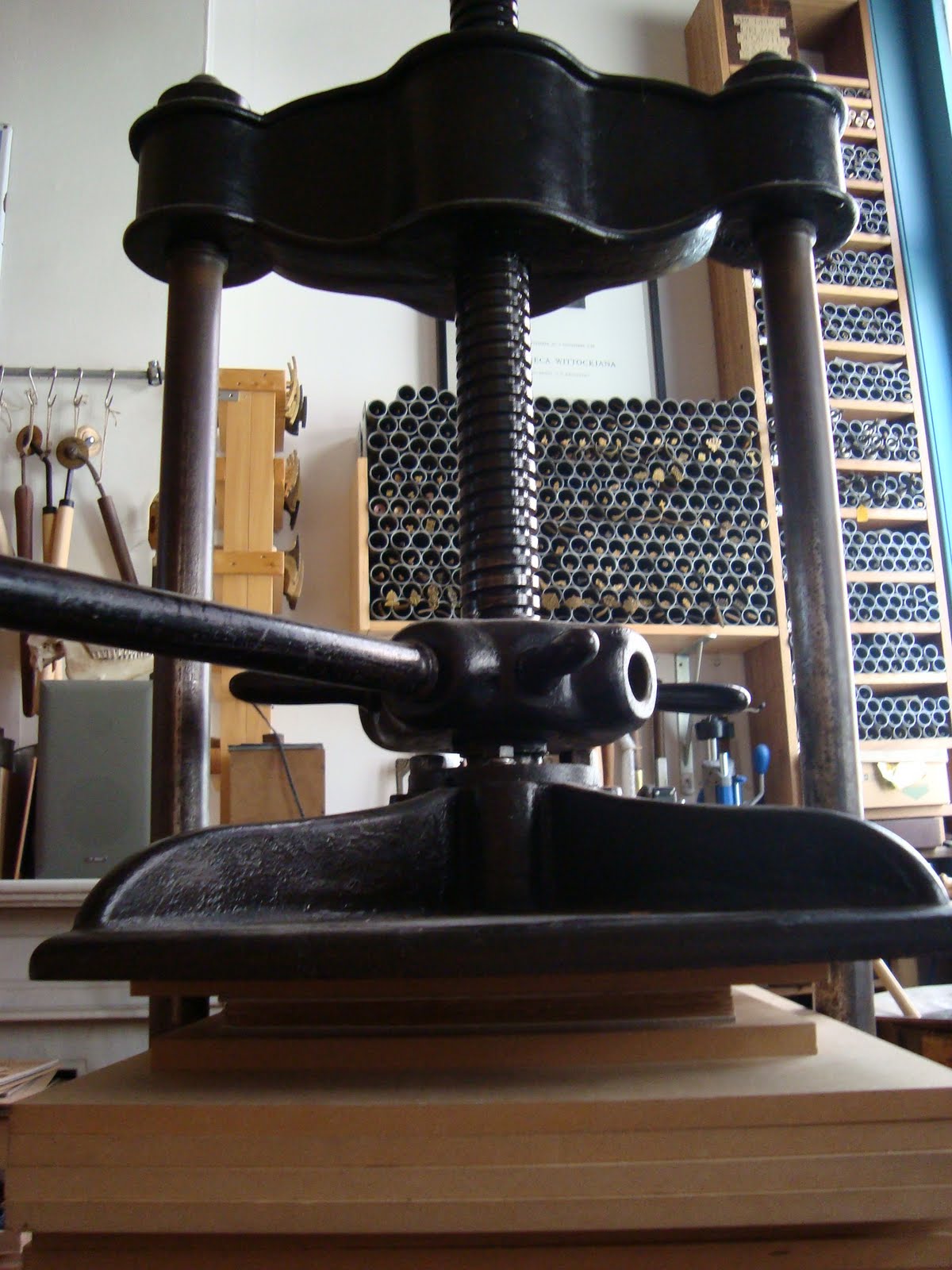
Tenslotte wordt het hele boek geperst 24 uur (gebruik nooit teveel druk wanneer je etsen perst,.. anders pers je de "moet" eruit), doel hiervan is om de lucht uit het boek te krijgen, zodat een solied boekblok ontstaat,....
Finally, the whole book pressed for 24 hours (do not use too much pressure when etching are in the book otherwise you erase the markings of the etchingplates). The aim of this final pressing is get lost of the air between the leaves, so that a solid book block arises.
Vervolgens wordt het boek terug samengesteld en volgt er een laatste controle op de volgorde van de katernen.
Then the book is put back together and there is a final check on the order of the signatures.
De laatste voorbereidende handelingen.
Eerst worden beschermkaternen toegevoegd. Deze katernen komen voor en achter het oorspronkelijke boek en vormen een beschermende buffer. Meestal gebruik ik hiervoor Restauro papier van Zerkall: een mouldmade, 100% katoen, acid free en erg mooi papier. Maar ook de gekende papieren van Griffen Mill komen hiervoor in aanmerking.
The last preparatory things to do.
First I add some protection signatures. These sections are put before and after the original book and they goal is to form a protective buffer. Usually I take Restauro Zerkall paper: a mould made, 100% cotton, acid free and very beautiful paper. But the wellknown Griffen Mill papers are also very good.
Subscribe to:
Posts (Atom)