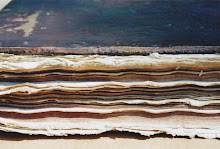
Some pictures of the result of the workshop K118 that I gave this month to a club of enthusiastic northern neighbors.
Showing posts with label K118 Binding. Show all posts
Thursday, November 15, 2018
A workshop K118: some impressions.
Enkele foto's van het eindresultaat van de workshop K118 die ik deze maand heb mogen geven aan een club enthousiaste noorderburen.
Saturday, March 5, 2011
K118: Grand écart
De K118-binding blinkt niet zozeer uit qua vormgeving maar vooral door zijn verbazingwekkende soepelheid (en sterkte). Het boek opent buitengewoon goed. De rug neemt spontaan een concave vorm aan bij het doorbladeren. Als proef op de som kun je het boek ook 360° openen. Zonder druk op het boek uit te oefenen raken beide borden elkaar: een grand écart als het ware. Het is weinig bindstructuren gegeven.
The K118-binding does excel of its amazing flexibility (and strength). The book opens extremely well. The spine takes a concave form spontaneously when browsing trough the book. You can also open the book 360 °. Without adding pressure on the book the two boards are touching eachother: a grand écart. It is given only a few binding structures.
Sunday, February 27, 2011
K118: Covering & Finishing
Voor het bekleden heb ik kangoeroeleder gebruikt met een "shrunken grain". Deze soort heeft een uitgesproken "nervatuur" aan de haarzijde. Het kangoeroeleder wordt gemaakt van in het wild levende dieren waardoor littekens en onevenheden er eigen aan zijn. Een groot voordeel is dat dit soort leder de naam heeft om extreem sterk te zijn.
Voor de decoratie is er gebruik gemaakt titelvergulden op de rug en een paneelstempel en kader op de platten. Alle decoratie in blinddruk.
For the covering I used kangaroo leather with a "shrunken grain". This leather has a distinct grainside. Because the kangaroo leather is made from wild animals , scars and marks are inherent. A big advantage, is that this type of leather has the reputation to be extremely strong.
For the decorations, I used atitle on the spine and a panelstamp on the boards. All the decoration are made by blindtooling.
Sunday, February 13, 2011
K118: Board attachment
De borden zijn samengesteld borden. Hiervoor worden 1,6 mm kartons op elkaar gekleefd. Aan elke zijde worden registerpapieren gekleefd. Nadien worden de borden geschuurd. Tenslotte worden de borden met de touwen en de perkamenten flapjes vastgemaakt aan het boekblok. De flapjes worden deels onderaan en deels bovenaan het bord bevestigd.
The boads are laminated boards. For this purpose 1.6 mm cartons are glued together. On either side of teh boards are papers glued. Afterwards the boards are sanded. Finally the cords and parchment flaps toare used attached the boards to the book. The flaps are placed partly underneath and partly above to boards.
Sunday, February 6, 2011
K118: Linings
As spine lining I use Fraynot. A second lining is made of vellum. The vellum is provided with flaps for the board attachment.
Saturday, January 29, 2011
K118: Headbands
Kapitaalbandjes: omdat de rug extreem flexibel blijft is een gewoon rechttoe rechtaan kapitaalbandje aangewezen. Geen zijdedraad, perkamenten/lederen kern maar een stukje linnen touw en (gekleurde) linnen naaidraad. Door zijn eenvoud blijft het kapitaaltje in zijn vorm bij het openen.
Headbands: because the back is extremely flexible we need just a straightforward headband. No silk, parchment / leather but a core piece of rope and (colored) linen sewing thread. Because of its simplicity it remains in its form when opening the book.
Saturday, January 22, 2011
K118: Sewing
De K118 is schitterende aanvulling op de vele reeds beschreven Gotische bindwijzen (zie Szirmai, The archeology of medieval bookbinding). Op het eind van de jaren 80 van vorige eeuw ontdekte Bruce R. Levy tijdens een restauratie deze bindwijze. Het artikel dat hij hierover schreef kan je terugvinden op http://cool.conservation-us.org/coolaic/sg/bpg/annual/v06/bp06-08.html
De K118 dankt zijn naam aan de boekbinderij die deze boeken gebonden heeft in 1493. Via de verguldstempels kwam men uit bij Nurembergse binderij K-118 in Kyriss "Verzierte Gotische Einbande Im Alten Deutschen Sprachgebiet". Wat deze binding onderscheid van andere bindwijzen is de enorme soepelheid bij het openen, het bijna vlakke openen van de pagina's en de stevigheid.
In deze reeks volg ik de variatie van de K118 zoals deze ontwikkeld is door Terry Buckley en Gene Mahone.
Stap 1: Naaien van het boekblok: met touw, linten, of koptisch,.... alles is goed. Hier gebruik ik plyster linten. Omdat ik de bestaande naaigaten terug heb gebruikt is de verdeling niet geheel volgens het boekje,...
The K118 is wonderful addition to the many already described Gothic binding methods (see Szirmai, The Archaeology of medieval book binding). At the end of the 80thies of last century Bruce R. Levy discovered, during a restoration, this binding. The article he wrote about the restoration can be found on http://cool.conservation-us.org/coolaic/sg/bpg/annual/v06/bp06-08.html
The K118 is named after the bindery who bound these books in 1493. Through the gilding tools they came out at the Nuremberg bindery "K-118" in Kyriss "Verzierte Gothic Einbande Im Alten Deutschen Sprachgebiet". What distinguishes this binding of other binding methods is the enormous flexibility in the opening, nearly flat open of the pagesand firmness.
In this series I follow the variation of the K118 as developed by Terry and Gene Buckley Mahone.
Step 1: Sewing the text block: with ropes, ribbons, or Coptic,.... they are all good. Here I use plyster ribbons. Because I have used the existing sewing holes again, the sewing stations are not as usual...
Subscribe to:
Posts (Atom)